Will We Notice When Art And Culture Is Diminished by Our Own Vocabulary?
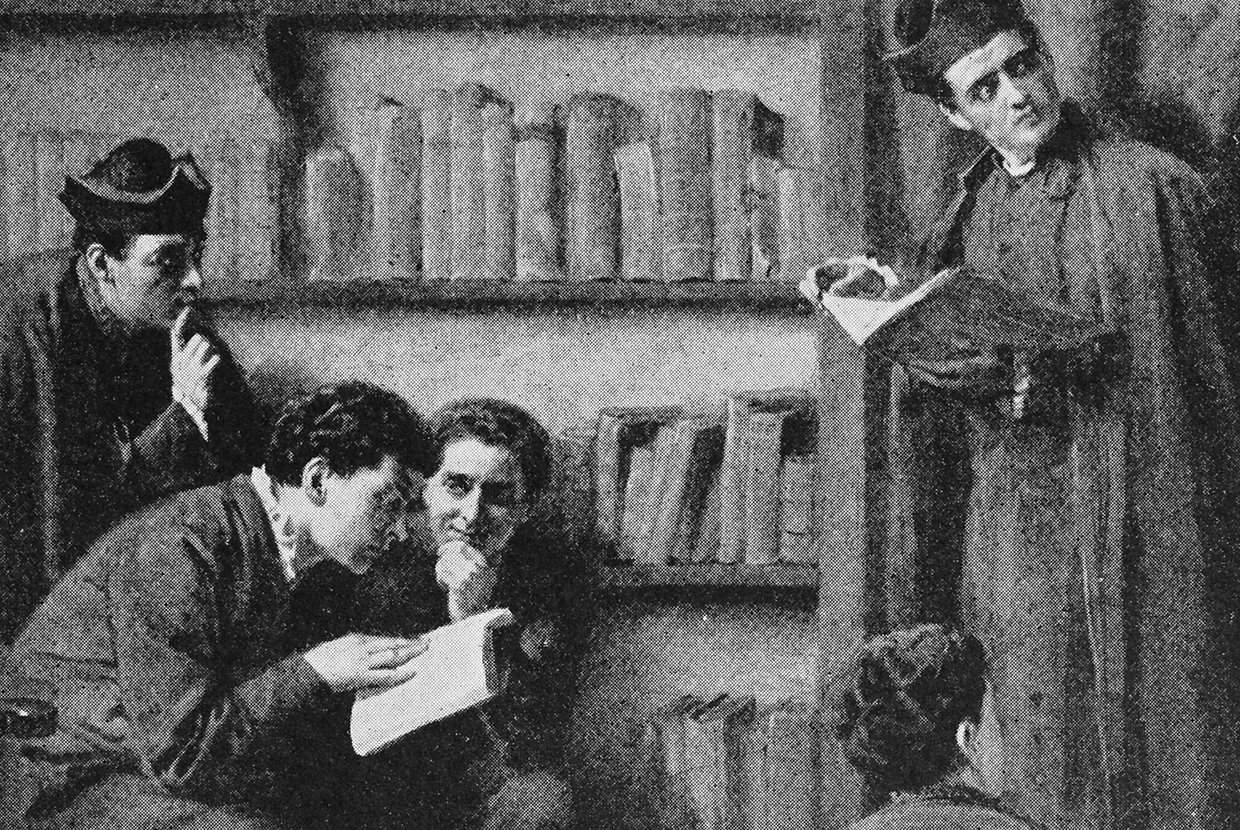
Detail of a print based on a painting by John Bagnold Burgess, (British, 1830–1897).
The year-long inquiry On Books at Curious Matter has heightened our awareness of what we’re reading. We read for research, for pleasure, for news. Locally, with tax hikes looming, the bulletins from city hall, the editorial reactions, and the stream of social posts have made budget talk an outsized presence. Political language has its own momentum. Certain phrases gain authority simply by being repeated. As we read, we become increasingly aware of what gets left behind when certain words or phrases become rote.
Months before the budget deficit and tax hike took over the news cycle, it was with disappointment that I had moved on from the vision for the arts held within the project Pompidou x Jersey City. I’d been a vocal supporter, but resigned to the new mayor’s choice to halt its further development and execution. He declared it “dead.” Yet, even after its demise, references to the project have continued to appear in statements from city hall, in media, and from opponents via social media. It lingers in the conversation, elevated into the city’s defining symbol of fiscal restraint. The defeat of the “French Museum” has been touted as a triumph over wasteful spending. But these statements aren’t merely financial reports, they reveal the vocabulary employed to discuss and frame our investment in art and culture.
In thinking about the language of art and cultural investment in Jersey City I wondered why Pompidou x Jersey City continues to be referred to as the “French Museum”. What does it mean to use this phrase? The mayor has used it in his communications, the local press uses it, and even local arts leaders have used it. Whether one supported the project or not is almost beside the point. The question that interests me is why some people stopped using the actual project name. What gets hidden and then evaporates when we use the replacement phrase “French Museum”?
I sometimes wondered if my own language needed a more brawling edge to match and challenge the hyperbole and name-calling that was employed by the Pompidou x Jersey City opponents. Should I have traded precision for provocation? It’s tempting to leave behind our most considered positions and instead vent unfiltered. But where would that leave the conversation?
I listened to that most common of tactics to diminish a perceived foe—rename and reduce. “French Museum” works to misdirect the discussion on many levels. It feeds into a perception that a museum is an elitist venture. The phrase invites associations with luxury, sophistication, and foreignness—making false equivalencies remarkably easy to construct. “How can we justify this extravagance in the face of the need for basic services?” Every mayoral candidate aligned with this time-tested technique to shift the conversation. It was an easy win all around and handily bypassed the question of whether they held a vision for the arts and culture.
So, what did the phrase “French Museum” help make disappear? Most immediately apparent is “x Jersey City”. How would this project serve Jersey City, its citizens? What would be created, and what would result? Those questions evaporated. The entire project was transformed into an exotic import divorced from the needs of the community. Centre Pompidou is in fact a French museum but that was never the proposal. “French Museum” doesn’t just erase the identity and intention of Pompidou x Jersey City, it perpetuates a discourse that continually positions culture as an extravagance and not a civic responsibility. Whether Pompidou x Jersey City was negotiable, valuable, or visionary was not addressed. None of that was relevant after Pompidou x Jersey City was replaced with “French Museum,” or in some cases simply Pompidou. When “x Jersey City” disappeared from the name, a partnership disappeared from the conversation. Goodbye, Jersey City.
"French Museum" wasn't the only phrase that took hold. "Vanity project" was another repeated phrase. It emerged at a moment when many residents were understandably worried about affordability, taxes, and the pressures of everyday life. But once that phrase grabbed on, it diverted another question: what role should art and culture play in the life of a city, even during difficult times? Eventually I became less interested in the words that were repeated than in the words that never appeared. I didn’t hear about inspiration, curiosity, discovery, possibility.
Cities don't simply fund art and culture, they define it. The words we repeat—and the ones we abandon—shape not only our conversations, but what is possible. As we decide what kind of city we hope to build, we might first ask whether our vocabulary is equal to our imagination.