Curator’s Notebook: Erasure Gallery 2026—Missing from the Library
On the occasion of Jersey City Pride 2025, Curious Matter made a call for queer visibility by provisionally renaming itself Erasure Gallery, “a temporary and occasional action…to transform the gallery into a site of remembrance, reflection, and resistance. [T]o acknowledge the countless queer artists, writers, thinkers, collectors, and appreciators whose full stories have been lost to systemic bias and archival silence.” As we begin considering Erasure Gallery 2026, we find ourselves returning to those questions through the lens of our current year-long inquiry, On Books: The form, flow, and force of books.
One of the central questions animating On Books is how ideas circulate. Books move through archives, bookstores, classrooms, collections, libraries, and private hands. They shape how knowledge is preserved, shared, and transmitted. Revisiting Erasure Gallery, we ask: What happens when that flow is interrupted? How are ideas restricted, suppressed, or removed from circulation? What happens when entire communities are omitted from the historical record?
Book burnings, censorship, obscenity prosecutions, archival silence, institutional neglect, and the exclusions embedded within systems of cataloging and preservation all suggest that access is not neutral. The circulation of ideas can be interrupted, histories obscured, and voices forgotten. For the first time, we thought we would share a Curious Matter Curator's Notebook entry before an exhibition has taken shape. Rather than reflecting on the completed project, we wanted to invite you into the early stages of our inquiry, while questions and possibilities remain open.
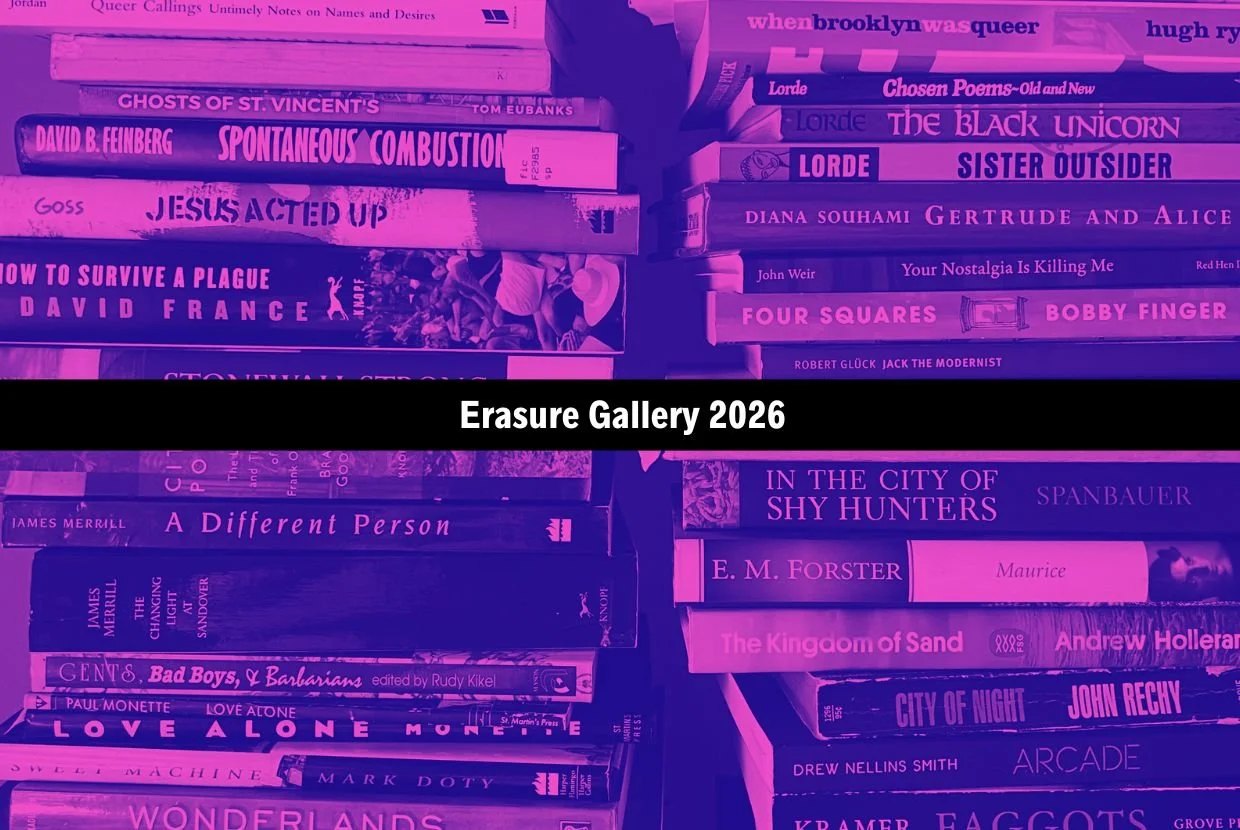
Our first step in considering Erasure Gallery 2026 has been rather simple. We pulled from our personal library, from the shelves and from the stacks that lean against every wall in our bedroom and that occupy the entire space under our bed—the books that have shaped our understanding of gay and queer lives, histories, communities, and culture. We dusted them off, gathered them together, and as we proceeded, sorted them into thematic piles. The result was a collection of roughly seventy volumes accumulated over decades of reading. Some were familiar favorites, read, and reread over time, like the poems of Frank O’Hara or passages from James Merrill. Others hadn’t been opened in years.
One surprise was the significant gap in our collection of some of the most foundational works—those books that had been most significant to our young gay selves. A Well of Loneliness by Radclyffe Hall, Our Lady of the Flowers by Jean Genet, anything by James Baldwin, or Christopher Isherwood were absent as well. These were the companions to our coming out, to finding ourselves reflected in the wider world for the first time. It’s easy to imagine these books being loaned to friends and forgotten, or left behind in any number of residential moves. In the context of this project, the gap felt poignant. These absences were not the result of censorship, but of ordinary life. We never set out to build an archive of our reading. Books come and go.
The library we discovered is idiosyncratic at best—for example, 3 copies of Paul Monette’s Love Alone for unexplained reasons. While the missing classics have ignited a nostalgia and desire to reintroduce some of them, the current collection highlights more recently discovered authors like Nate Lippens and publishers like Pilot Press. As we sorted and grouped, certain themes occupied the most towering piles. The AIDS crisis found voice again and again. So did queer art histories. A recurring presence was David Wojnarowicz. His voice and legacy surfaced repeatedly, resonating with many of the questions that first inspired Erasure Gallery.
What began as a search for an exhibition idea became a meditation on our relationship to our reading, what we hold onto, what gets left behind, and what ideas still linger. The books on the bed were far from a complete record of the queer and gay authors and subject matter we’ve encountered. What remained recalled for us our history, when we may have lost certain volumes, why others might still be in our possession, and what is driving our current reading. Beyond the inevitable gaps and omissions in our own library, each book nonetheless testified to the persistence of queer and gay voices despite the many forces that have historically sought to suppress, obscure, or erase our lives.
We are still determining where this inquiry will lead. As we consider the possibilities, we’re reminded that personal libraries are records, fallible though they may be, of affinity, influence, memory, and care. They reveal not only what has survived, but what we have chosen to carry forward.