Curator’s Notebook: Ordinary Work, The 2025–2026 Curious Matter Holiday Installation
Curator’s Notebook is an ongoing series of behind-the-scenes observations from the curators of Curious Matter—a place for reflection, context, and insight. As arts coverage continues to diminish, we offer these writings to deepen engagement with the work we do and to preserve the stories that unfold in our gallery.
Our annual holiday installation is an unusual tradition for a contemporary art space. It engages an openly devotional visual vocabulary with the intention of identifying what is universal in its ethical concerns and human aspirations, while remaining attentive to institutional failures and exclusions. We explore ritual and devotion without prescription. The project is aligned with our commitment to inquiry, yet it is also deeply personal.
Sometimes the holiday installation responds directly to the year just coming to a close; at other times it reflects more broadly on what connects us as humans and how we express our finest ideals—especially during the long dark nights of winter. To do this, we return again and again to the devotional visual language that shaped us—not to assert institutional alignment, but to ask enduring human questions through a vocabulary we know intimately. This year’s iteration was shaped not only by the objects we chose, but by the conditions under which we continue to work—conditions that remind us daily that attention, care, and continuation are not abstractions.
This winter, our attention gathered around the Miraculous Medal and the story of Catherine Labouré.
We hold several versions of the Miraculous Medal in our collection. One example, slightly larger than most and distinguished by its use of ajouré, or openwork, in its design, drew Arthur’s particular attention. The object itself is visually iconic, but it was Catherine’s life that felt most compelling. In returning to her story, Arthur was struck not by the miraculous visitations that have come to define her legacy, but by her daily existence: a life shaped by simplicity, routine, humility, and a thoughtful willingness to tend what was entrusted to her. From a life in which others held no great expectations, her devotion ultimately echoed across the world.
It was this ordinary devotion—rather than the miracle—that felt most resonant at this time.
Raymond believed it would be possible to build the installation around the medal. We had featured a single object before, and while the piece was small, it could still be given presence in the gallery. But he resisted deciding too quickly how that object should be held in space. A vitrine was one option. A graphic intervention was another. The question was not simply how to present the medal, but how the installation itself might participate in the telling of Catherine’s story—how it might hold space for contemplation rather than merely display.
We gathered other relevant materials from our collection—prayer cards, a rosary bearing the medal, an entry on Saint Catherine from Lives of the Saints. We considered how these objects and artifacts might complement the featured medal and elaborate the story.
As we visualized possible configurations, Raymond’s own studio practice began to enter the conversation. His ongoing project, Banderoles, the Apophatic Sky, and the Memorializing Artifact, had already been exploring related concerns: how absence is marked, how lost voices are imagined, how objects come to stand in for what cannot be held. What began as parallel thinking gradually shaped a curatorial approach to telling Catherine’s story.
Raymond responded by creating four large prints based on a prayer card and an illustration of Catherine. In paired compositions, figures appear and then withdraw. What remains is not loss, but atmosphere—sky, garden, air, the space where something once occurred. These works do not attempt to explain the spiritual. They allow it to recede, leaving only anamnesis—a remembering that is felt rather than seen. In the installation, they function as both witness and place of meditation. In this way, the prints do not illustrate Catherine’s story, but offer a parallel language for considering how meaning persists after revelation withdraws.
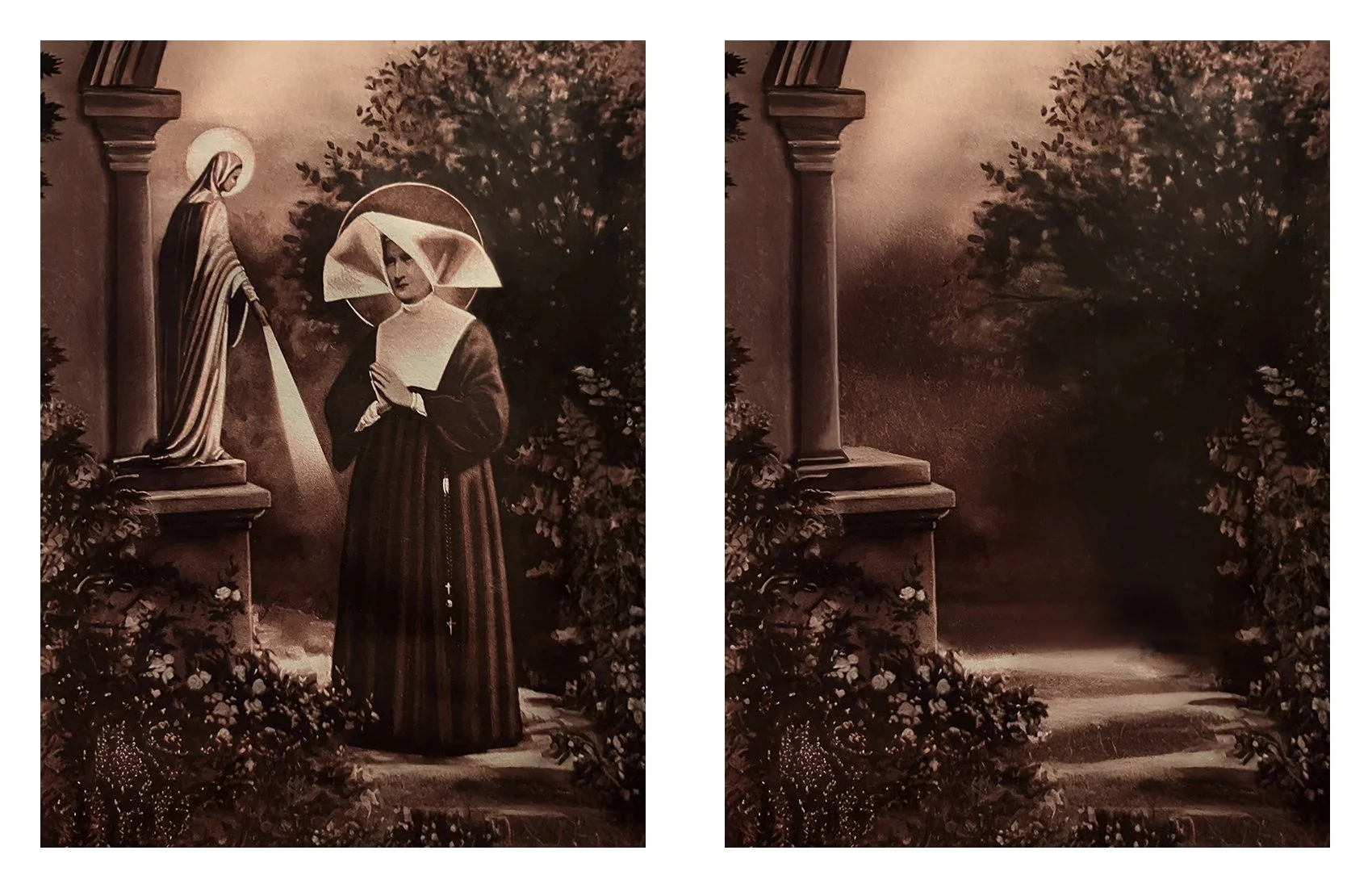
Raymond E. Mingst, Untitled (Prayer Cards), 2025
This attention to ordinary devotion has felt especially present for us this year. Arthur continues to live with cancer as an ongoing condition—one that has not diminished his commitment to his art practice, but has sharpened our awareness of time, and the focus of our commitments. We have learned how quickly others wish to declare a battle conquered, how eager the language of triumph can be. Our own experience has been more ongoing, and more attentive. It has asked us to consider what we wish to continue, what we might release, and how our work can remain responsive to life as it is currently experienced.
As is our tradition, the essay and images from the installation were printed as a card and sent to our postal list. This gesture remains central to the holiday installation for us. It is not documentation alone, but an offering—a way of carrying the work outward to our community.
Ordinary Work, as with all of our holiday installations, does not ask for the story to be believed as phenomenon, but to be considered as intention. And perhaps that is what we return to each winter: the hope that our finest intentions might serve as a form of care—and that care, practiced with humility and without spectacle, might still be capable of carrying light.
Raymond E. Mingst | Arthur Bruso