After Pompidou: Cultural Ambition and Civic Obligation
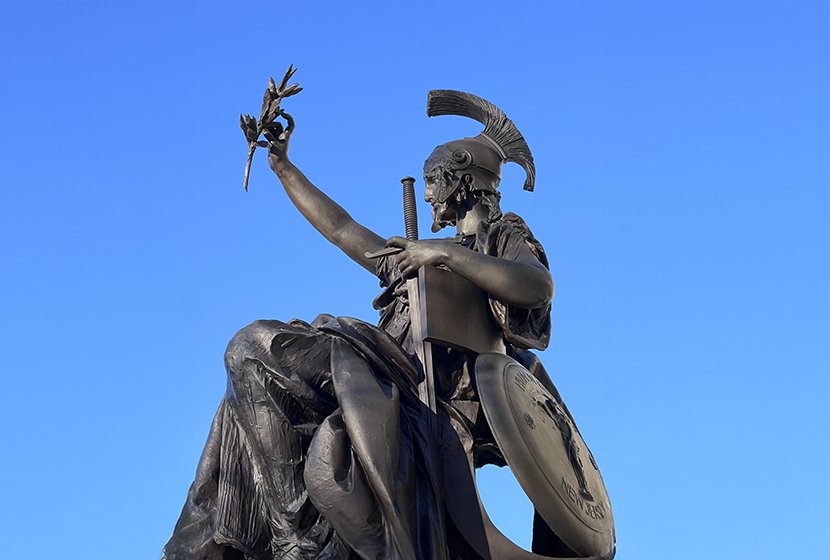
Soldiers’ And Sailors’ Monument at City Hall in Jersey City, sculptor: Philip Martiny
In recent days, following the decision to halt Pompidou x Jersey City, a familiar refrain rushed in: we never needed it; we already have great art here. Repeated often enough, this claim threatens to calcify into local lore. But that claim deserves closer examination. A city’s cultural health cannot be measured solely by the presence of local art production, or by how confidently a small circle reaffirms itself. Culture is a public obligation, not a closed loop. Moments like this call for a less reductive stance, to ask a more difficult question: what does Jersey City believe it owes its citizens in terms of serious cultural engagement with the arts?
To say that a city has artists is not the same as saying it has a cultural ecosystem that serves its people. Support for local makers is essential, but it does not, on its own, fulfill a city’s cultural obligation. It is the city’s responsibility to create conditions for learning, exchange, and growth, to introduce students and residents to ideas and practices beyond what is already familiar.
The language of “local pride” can become a shield against rigor. The assertion that we already have great art here is only meaningful if paired with a commitment to expansive inquiry and exchange. Otherwise, local pride functions merely as a means to protect itself from critique. A culture that congratulates itself without looking beyond its immediate borders does not become stronger, it stagnates.
The case for broader exchange is not a case against local production. It is a case for the idea that audiences deserve access to work and thinking that expands possibilities and imaginations. Exchange does not discredit or erase what makes a city unique; it is how we speak with the wider world. Cities that take culture seriously understand this. Global engagement is not elitism, it is a required condition for public learning.
It was in this context that I initially supported Pompidou x Jersey City. My interest was not rooted in its institutional status, but in how the organization might operate within Jersey City. I was interested in what it could introduce, and how it might expand the city’s sense of itself as a participant in a larger cultural conversation. Over time, my partner and I met with members of the Pompidou x curatorial team and attended several public programs, including Night of Ideas. These encounters offered a glimpse of what thoughtful international exchange could look like here. Rather than a distant entity, I encountered committed cultural workers sharing insight, expertise, and experience. I offer this not to counter other criticisms, but to acknowledge that the story of Pompidou x involved far more than institutional branding.
What energized me, as someone outside the political orbit of the administration that initiated the project, was the possibility of serious cultural exchange—the chance for Jersey City to be in conversation with artists, curators, and ideas beyond our immediate borders. These possibilities did not resolve the project’s deeper structural challenges, but they revealed what felt like a rare opportunity. At the same time, it became increasingly clear that Pompidou x Jersey City struggled to align its ambition with public trust. Governance structures were not yet clearly articulated, financial shifts eroded support, and the project’s public-facing language was often read as inconsistent rather than evolving. For an initiative asking for significant public investment, ambition alone was no substitute for clarity and accountability.
But failure should not be misread as proof that cultural ambition itself is irresponsible. With the decision to halt Pompidou x Jersey City, the city now enters a period of recalibration. In moments of fiscal reckoning, cultural projects often carry outsized symbolic weight. They become convenient scapegoats for broader financial or political missteps. At times like these, those at the podium can easily trade in reductive soundbites. What was complex becomes “vanity” and what involved years of labor and thought, collapsed into a cautionary tale.
If the failure of Pompidou x Jersey City becomes solely synonymous with excess or vanity, we risk the future of all cultural initiatives that look beyond our front door. Any significant, outward-facing initiative will be in danger of dismissal due to past failures of execution, instead of being judged for their actual merits. In moments like this, there is a temptation to keep ourselves small and insular, to retreat into familiarity and limited vision. That temptation may feel prudent. It is not. It contributes to the insidious lowering of the bar for what a city expects of its cultural life, and what it offers its people.
What follows the end of Pompidou x Jersey City should not be a retreat from vision, but a more demanding standard for how vision is pursued. Jersey City deserves a cultural ecosystem grounded in rigor, transparency, and exchange—one that understands culture as civic infrastructure rather than ornament or trophy. What matters now is the care with which ideas are developed, trust is built, and differing perspectives are held in serious, ongoing dialogue.
Cultural life is eroded not only by overreach or excess, but by the gradual acceptance of lowered expectations and diminished imagination.