
Ordinary Work
The 2025-2026 Curious Matter Holiday Installation
December 24, 2025 – January 31, 2026
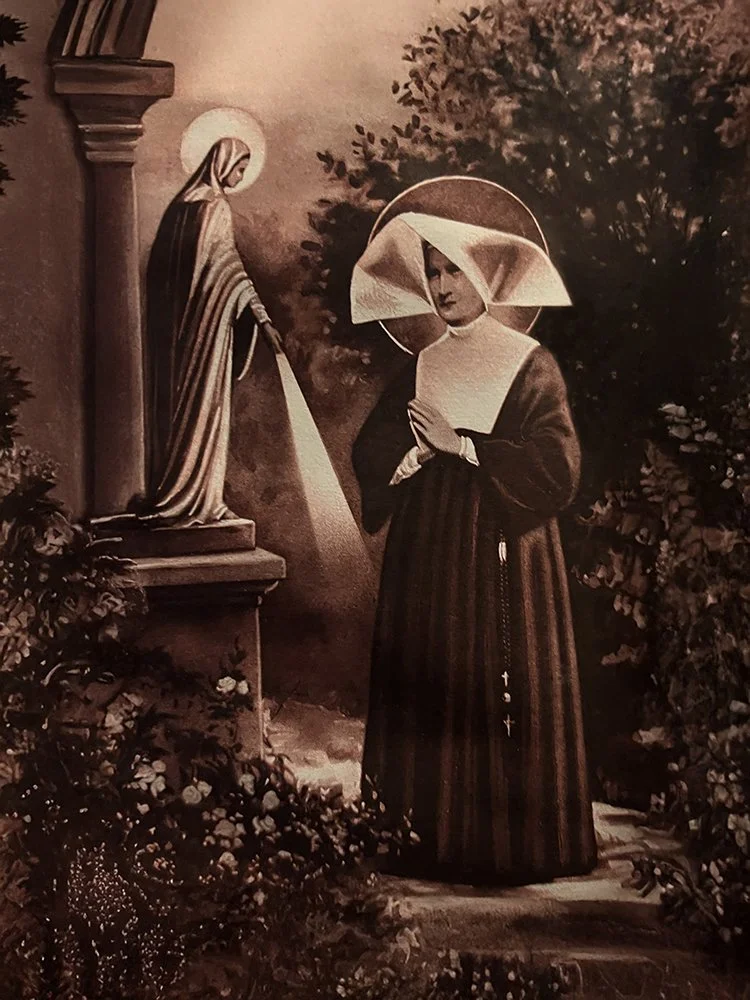
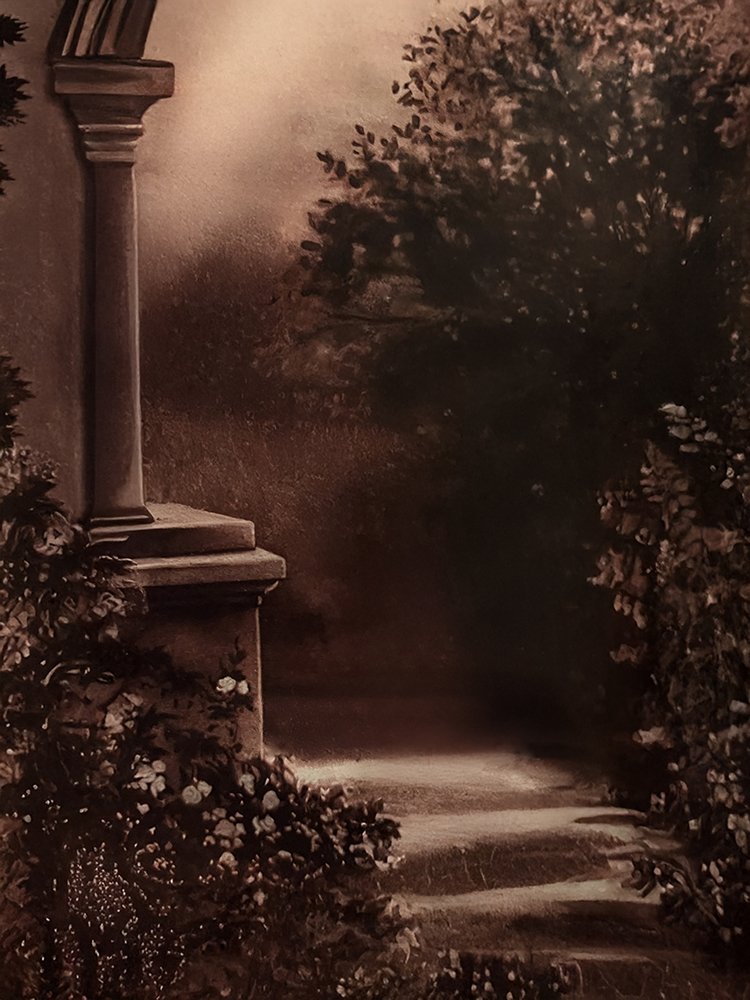
Raymond E. Mingst, Untitled (Prayer Cards), 2025
“I knew nothing; I was nothing. For this reason, I was chosen.” —St. Catherine Labouré
The days are short, the dark settles early. Each winter, our annual holiday installation engages a visual and narrative language that is foundational to us: the imagery and lessons of the Roman Catholic Church. While the ideas we explore are broadly human and widely shared, the language through which they are expressed is culturally specific, shaped by devotion, ritual, and tradition. Our project is offered as a celebration of light, undertaken with full awareness of the Church’s long history of institutional failure — harms and exclusions that have counted us among the ostracized. This reality cannot be set aside. Still, we remain attentive to the images, stories, and ethical aspirations that endure beyond the institution’s authority. Ideals of justice, care, humility, and grace, however imperfectly held, continue to shape our moral imagination.
This year’s installation turns toward the story of St. Catherine Labouré.
Catherine was not distinguished by talent or ambition. Born into a farming family, she was dutiful and accustomed to work that went largely unnoticed. After the death of her mother, she assumed domestic responsibilities at home, and later entered the Sisters of Charity as a novice at the age of twenty-four. Her days were filled with routine tasks: kitchen work, tending animals, maintaining the ordinary rhythms of convent life. She did not seek attention, nor did she imagine herself marked for anything extraordinary.
It was from within this unremarkable life that Catherine experienced a series of visions in 1830. In the first, she was awakened in her cell by a luminous child who led her to the cloister chapel. Though locked for the night, the doors opened easily. Inside, the chapel appeared brightly lit, as if prepared for a Midnight Mass. Seated in the Spiritual Director’s chair was the Virgin Mary, whom Catherine later described as “the most beautiful woman I had ever seen.” She knelt beside her and rested her hands in Mary’s lap, experiencing the warmth and solidity of her body. Mary spoke to Catherine of suffering and upheaval to come, and told her that God wished to entrust her with a mission.
In subsequent visitations, that mission was revealed. Catherine was to act as an intercessor, and to have a medal produced according to a design Mary showed her. In this image, Mary stands upon a globe, crushing a serpent beneath her feet. Rays of light stream from her open hands, extending toward the world below — signs of grace offered to those who ask for it. Encircling the figure are the words: O Mary, Conceived Without Sin, Pray For Us Who Have Recourse To Thee. The reverse of the medal bears the letter M intertwined with the cross, flanked by the Sacred Heart of Jesus and the Immaculate Heart of Mary, and surrounded by twelve stars.
Catherine was instructed to bring this design to her confessor. It took more than two years for her account to be believed and for the medal to be produced. Church officials doubted both the authenticity of her visions and her capacity to articulate such complex theological imagery — particularly the phrase “conceived without sin,” which had not yet been declared official doctrine. What ultimately persuaded them was not eloquence or authority, but Catherine’s consistency, her refusal to claim credit, and her insistence on remaining silent about her experiences. Her description of Mary’s physical presence — her warmth and weight, her corporality — was taken as proof of the vision’s reality.
The first medals were struck in 1832. Following the completion of her task, Catherine requested she be assigned to the care of the sick and dying. She dutifully served and lived the remainder of her life in obscurity. Only on her deathbed did she speak of the circumstances surrounding the medal, which by then had become an object of devotion throughout the Catholic world.
Our installation brings together devotional materials of St. Catherine — prayer cards, pamphlets, a copy of Lives of the Saints, and examples of the Miraculous Medal — alongside four prints by Raymond E. Mingst. These prints engage the story of Catherine Labouré through presence and withdrawal. In paired compositions, figures are shown and then removed, leaving only atmosphere: clouded skies, a garden setting, the space where revelation once appeared. What remains is not negation, but a spiritual afterimage. This approach extends Mingst’s ongoing engagement with absence, and the memorializing gesture. The sky or the garden becomes a witness not to miracle, but to attention itself. These works do not seek to explain the encounter with the spiritual. Instead, they offer a pause, a breath in which absence is allowed to speak.
Catherine Labouré’s life suggests that devotion need not announce itself, and that what is entrusted to us may matter more than what we claim. This holiday installation is offered in this spirit: as an invitation to stand in meditation with images that withhold as much as they reveal, and to consider the forms of care, labor, and attention that persist beyond recognition and declaration.
As we enter this winter season and move toward a new year, we share these works with a sense of gratitude for time spent in looking, for moments of contemplation, and for the sustaining gestures of grace that carry light through darker days. May there be room, in the midst of all that asks for our attention, to notice what is modestly offered, and to offer ourselves in return. Each of us has their light to shine.
Yours,
Raymond E. Mingst | Arthur Bruso
Co-founders, Curious Matter