Erasure Gallery 2026 x On Books: David Wojnarowicz
July through August 2026
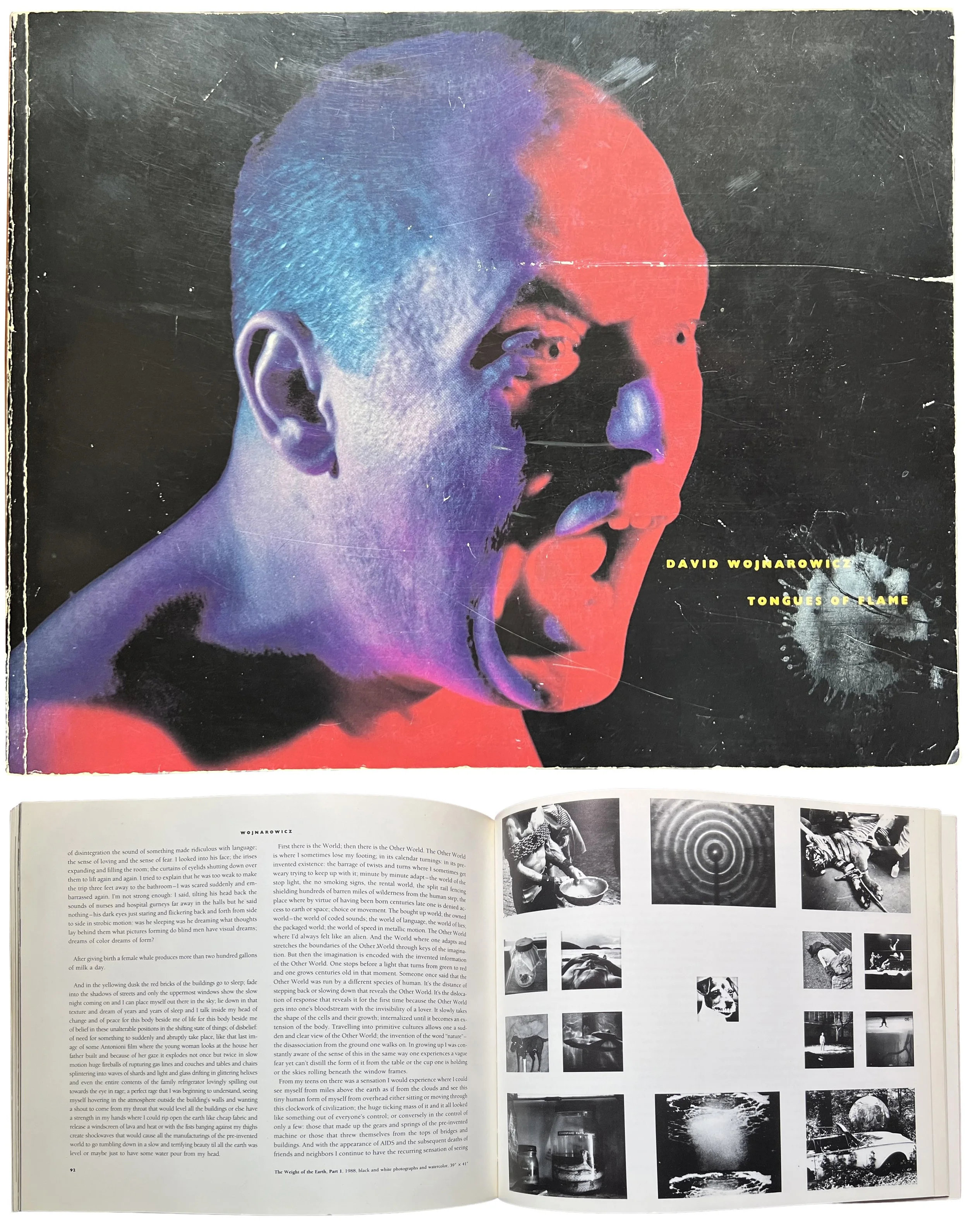
A well-worn copy of Tongues of Flame, and an interior spread from the catalogue.
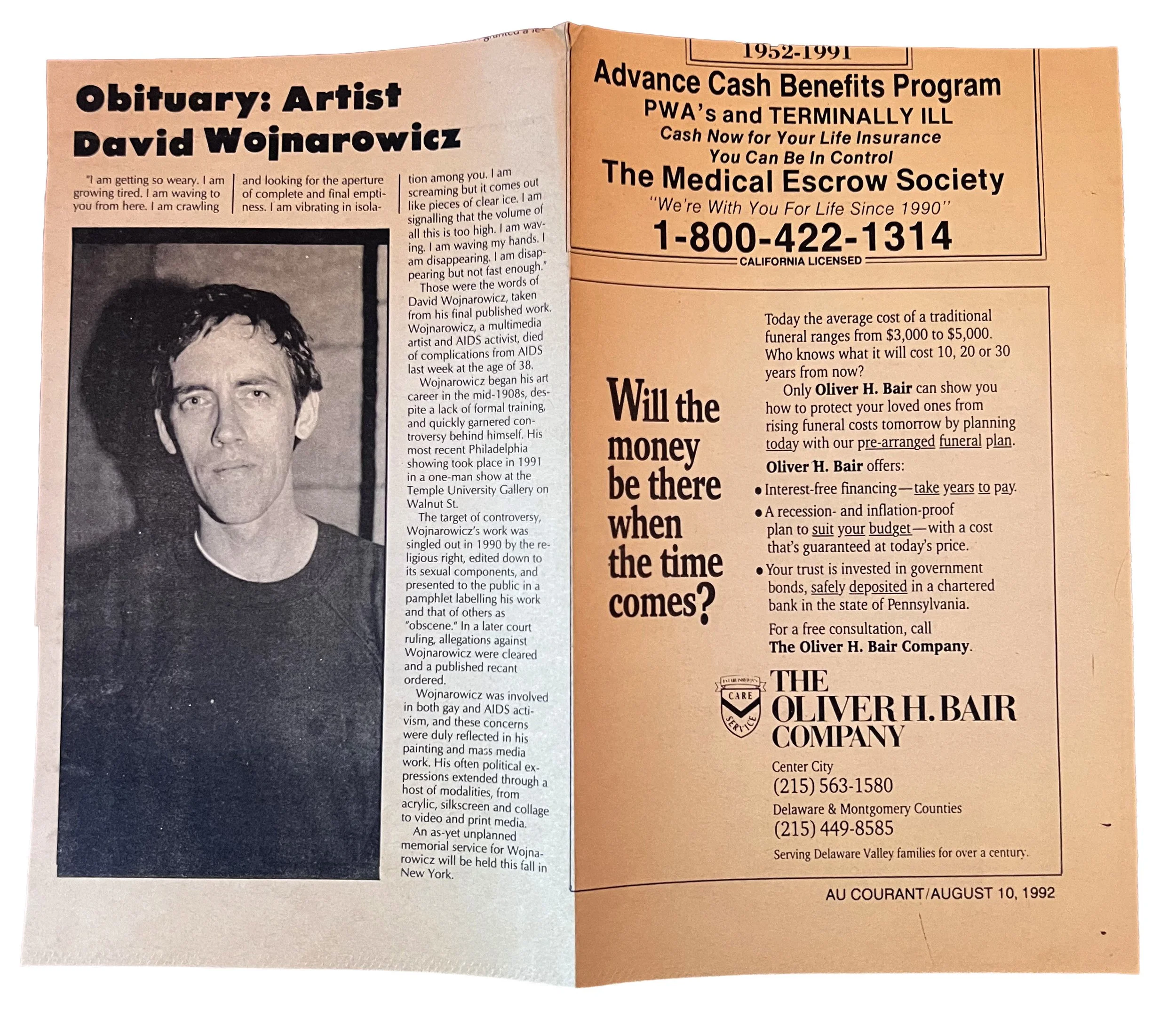
A clipping of David Wojnarowicz's obituary from the Philadelphia newspaper Au Courant, August 10, 1992.
Erasure Gallery was born in 2025 out of anger and frustration in the face of the seemingly relentless erasure of gay and queer stories from our cultural record. Recent exhibitions that effectively straight-washed the biographies of Winslow Homer and John Singer Sargent at the Metropolitan Museum of Art (1) were particular catalysts for our action. We sought to reckon with the failures of museums and curatorial practices to present full, dimensional gay and queer lives in the visual arts. We called for more expansive interpretive frameworks to foster a more inclusive and honest understanding of our cultural heritage.
Curious Matter adopted the provisional name Erasure Gallery during August, the month in which Jersey City celebrates Pride. We invited institutions within our local community to consider these concerns and share our program with their members. We were honored when the Museum of Jersey City History chose to install a parallel exhibition of Erasure Gallery and host a public conversation.
We have decided to continue this temporary renaming as an annual practice. For 2026, our approach has been shaped by the gallery's year-long inquiry, On Books: The form, flow, and force of books.
As we considered this year's exhibition, we turned first to our own library. We pulled from our shelves and stacks as many books by and about gay and queer lives as we could find. We began sorting them thematically. Queer art histories occupied one of the largest groupings. The AIDS crisis appeared again and again. Throughout the process, books by and about David Wojnarowicz emerged as a significant and recurring presence.
We did not set out to make an exhibition about David Wojnarowicz. Yet the more we looked—encountering his journals, essays, catalogues, and biography—the more his voice seemed to guide the inquiry. As an artist, writer, and activist, Wojnarowicz occupies a singular position at the intersection of many of the questions that first inspired Erasure Gallery and continue to animate our On Books inquiry. His work moves fluidly between visual art and literature. It bears witness to the AIDS crisis and to the conditions of gay life in late twentieth-century America. It has also repeatedly been subjected to suppression, censorship, and institutional retreat.
The assaults on the full expression of Wojnarowicz's work are well documented. From the controversy surrounding the catalogue accompanying Witnesses: Against Our Vanishing (2) to the removal of his film A Fire in My Belly from Hide/Seek: Difference and Desire in American Portraiture (3), his work has frequently become the object of fear, misunderstanding, and hostility toward gay and queer lives. Yet these confrontations are not the reason his books occupy such a significant place in our library.
We do not return to David Wojnarowicz because his work was accused of obscenity. We do not read him because funding was rescinded or exhibitions became sites of political conflict. While these struggles remain central to understanding the mechanisms of cultural erasure, they are not what continues to draw us to his work. We return to David because of the work itself—its honesty, urgency, anger, and refusal of silence; its capacity to hold friendship, desire, and love amid extraordinary loss. We return to it because it continues to articulate truths about our lives and because it still possesses the ability to move us deeply.
Rather than presenting another account of censorship and litigation, Erasure Gallery 2026 turns toward the artist and the work itself. In addition to presenting books and ephemera within the gallery, we offer our personal reflections on finding, reading, and returning to the work of David Wojnarowicz.
Raymond first encountered his work on the streets of downtown Manhattan. He did not yet know the artist by name, but the burning house stencil was somehow shocking and seemed to transcend the graffiti imagery he was accustomed to seeing as a young art student in early-1980s New York.
Arthur encountered Wojnarowicz through Tongues of Flame, the catalogue accompanying the artist's 1990 exhibition at Illinois State University. Living in Philadelphia in the early 1990s, recently graduated from the University of Pennsylvania and feeling increasingly removed from his aspirations as an artist, he happened upon the book in a bookstore and found himself returning to it again and again.
For both Raymond and Arthur, their first encounters with David's work began with his imagery and the sense that something unfamiliar and significant had been discovered.
Later, reading Close to the Knives felt like a blast of recognition for Raymond. The book gave language to aspects of his own coming of age, a period marked by few rituals or guides for young queer people exploring sexuality. We made our way through experience, often at the margins and outside our known social circles. Encountering parallel experiences in David's writing was nearly as revelatory as living them. Close to the Knives did not shy away from predatory adults, hostility, or violence. Yet it was not simply the documentary aspects of David's writing that proved so compelling. It was also the artist at work—his prose, his looking, and the unflinching way he processed and translated lived queer experience into art.
For Arthur, the revelation took another form. The work seemed visually fresh and exciting. He was captivated by the way Wojnarowicz grouped multiple images, creating meaning through juxtaposition rather than through a single picture. Reading more about the artist's life proved equally consequential. His ability to rise from homelessness and profound precarity to become one of the most significant artists of his generation was inspiring, as was his resolute pride in his gayness. Wojnarowicz became not only an admired artist, but also a figure whose example suggested that another life and another artistic future might still be possible.
Erasure Gallery 2026 x On Books will continue through July and August. Our year-long inquiry into the form, flow, and force of books has taken shape in dialogue with our visitors. To aid the ongoing conversation around David Wojnarowicz, we have assembled a reading list and resource guide that extends beyond our own idiosyncratic collection and recollections to include information regarding his papers, journals, photographs, and other objects and artifacts.
Raymond E. Mingst | Arthur Bruso
Notes:
1. The exhibition Winslow Homer: Crosscurrents was presented April 11–July 31, 2022; Sargent and Paris was on view April 27-August 3, 2025, at the Metropolitan Museum of Art.
2. Witnesses: Against Our Vanishing, curated by Nan Goldin, at Artists Space in New York City, November 16, 1989–January 6, 1990,
3. Hide/Seek: Difference and Desire in American Portraiture co-curated by Jonathan Katz and David C. Ward, Smithsonian National Portrait Gallery, Washington, D.C., October 30, 2010– February 13, 2011
EXHIBITION NOTICE & FAIR USE STATEMENT
This installation features historical newspaper clippings, books, publication covers, and archival ephemera by and about David Wojnarowicz. These materials are presented for non-commercial educational, critical, and interpretive purposes.
The materials are included to contextualize and examine Wojnarowicz's artistic contributions, the history of anti-queer censorship, and the cultural erasure of LGBTQ+ narratives.
This presentation is intended to constitute Fair Use under Section 107 of the United States Copyright Act. All copyrights, trademarks, and intellectual property rights in the original materials remain with their respective creators, publishers, estates, and rights holders. The inclusion of these materials does not imply endorsement by or affiliation with the rights holders.